






Three first-time funds I watched raise in the past two years had a better story than the fund that beat them. They all lost in the same place: the data room. Not the pitch deck, not the carry terms, not the track record. The mess you could not see from the founder’s chair.
Here’s the pattern. An investor opens your room on a Tuesday. Half the folders are empty, the LPA sits in a PDF named “final_v3_actualfinal,” and nobody can tell whether the track record sheet is audited or self-reported. They close the tab and mentally move you to the bottom of the pile. No email, no rejection, just silence you spend six weeks misreading as interest.
If you are raising a first or second fund, your data room is the first real proof you can run a process. Platforms built for institutional fundraising, like Intralinks イントラリンクス (intralinks), exist because limited partners and placement agents expect a disciplined index long before they expect a great memo. You do not have to buy the premium tool on day one. You do have to think like someone who would.
What the data room actually proves to a limited partner
An LP cannot check every claim in your deck. They check your room. How you organize fifteen documents tells them how you’ll organize a portfolio company’s reporting, a capital call, an audit request, and an exit process. A messy room reads as a person who will forget to send the quarterly letter.
The regulatory backdrop reinforces this. Under the SEC‘s private fund rules, managers face growing expectations around reporting and recordkeeping, and any investor scanning your room is quietly testing whether the paperwork will survive scrutiny. Fundraising becomes a dress rehearsal for the compliance work you’ll live with for a decade.
I think most first-time managers treat the room as a storage locker. That’s the mistake. It’s a sample of your operating discipline.
Three leaks that quietly kill conviction
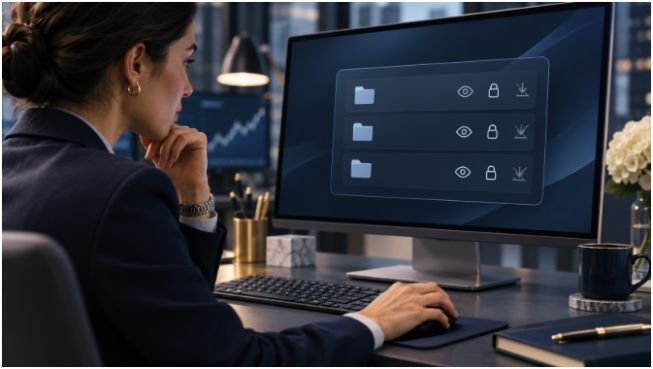
Documents that make an LP guess
A file called “Term Sheet v4” tells the reader nothing. Was this signed? Superseded? A draft you abandoned? Every document in your room should answer three questions before it’s opened: what is it, which version is current, and who can see it. That means a consistent naming convention across folders, and a clear top-level index that opens the room, not a wall of PDFs.
Access controls that look amateur
If you grant the whole room to an investor who only needs the marketing deck, you’ve told them you don’t think about information boundaries. Staged access is normal and expected. A placement agent gets the full picture. A prospective LP gets the deck, the track record, the terms, and access to the rest on request. When your access rules read as deliberate, the investor trusts the numbers behind them more, not less.
A Q&A process that stalls
Investors ask questions during diligence, and silence for four days reads as a red flag. A shared question log with dated answers—structured with the same discipline as data normalization in database management—kills the email chase and shows you respond fast. It also gives you a written record when the same question comes in from six parties.
The four-folder test

Before you send a single invitation, build the room around one test I’ve borrowed from managers who raise cleanly. Every piece of content has to survive these four folders, and nothing lives outside them.
- Story. Your deck, the executive summary, and a one page description of strategy and target sectors.
- Terms. The LPA, the PPM, fee schedules, and a plain summary of carried interest mechanics.
- Evidence. Track record with methodology, references, portfolio updates if you have prior vehicles, and the audits that back the numbers.
- Operations. Team bios, service providers, compliance documents, and a note on your reporting cadence.
If a document doesn’t fit one folder, it doesn’t belong in the room. That single rule clears out most of the clutter that makes investors hesitate.
Security habits that separate serious managers from hopeful ones
You are handling LPA terms, investor contacts, and portfolio financials, sometimes for parties in three countries. Basic hygiene matters here. Restrict downloads on sensitive documents where you can, watermark files that move outside the platform, and log who opened what. When a party asks for the same document twice, the access log tells you whether they lost it or never opened it. That’s an intelligence layer most first-time managers never think to use.
For a baseline on what “reasonable” looks like, the National Institute of Standards and Technology publishes a widely used cybersecurity framework that translates cleanly to a small fund with no IT department. You don’t need a security team to follow the fundamentals it lays out.
If your fund touches investors outside your home country, the question of where documents live and who can access them becomes a live legal issue, not a technical detail. Cross-border data handling is one of the areas the OECD has spent years mapping, and it’s worth an hour of your time before you invite an overseas LP into the room.
The checklist I’d run before the first invite

- Does the room open on a clear index page that tells a stranger exactly where to start?
- Is every document named to a convention a stranger could follow without asking?
- Are access permissions set by role, not by convenience?
- Do you have a documented Q&A log ready, with a named person responsible for answers?
- Have you tested the investor experience on a phone, since half your opens will happen there?
- Is there a named owner of the room, and does that person check activity twice a week?
The last one is the one I’d insist on. A room nobody watches is a room nobody trusts.
What this actually changes about your raise
Investors rarely tell you the room was the problem. They read your terms, scan the track record, and decide—much like how founders researching small business loan mistakes to avoid quickly learn that messy documentation kills deals before negotiations even begin. The room is where your story either holds together or falls apart under contact with a stranger.
Build it like someone you respect will audit it, because they will. The managers who raise cleanest aren’t the ones with the largest rooms or the fanciest platforms. They’re the ones whose files answer questions before they get asked. Which folder in your room would make you nervous if an LP opened it right now?